
Read Montgomery County Tax Records
Montgomery County tax records are not a single document. SDAT handles the assessment side and publishes those figures. Treasury then bills and collects the tax owed.
Keep each number tied to its keeper. The deed index answers who owns a parcel, not what is due on the tax roll.
| Field | What It Shows | Where |
|---|---|---|
| Current and base value | Full cash value and reassessment base | SDAT parcel card |
| Land and improvements | Separate parts of the total assessment | SDAT parcel card |
| Phase-in assessment | Value applied during the three-year phase | SDAT and tax bill |
| Bill and account | Eight-digit keys, year, charges, and status | County Treasury |
| Credits and occupancy | Relief or eligibility fields affecting tax | SDAT and Treasury |
| Delinquency or tax sale | Dated status, notice, result, and redemption steps | County tax-sale records |
Maryland's assessment is an estimate of full cash value for tax purposes. It is not an appraisal for a sale. The consideration stated on a deed is the recorded transfer amount. It may not reflect an arm's-length market price. The tax bill then applies state and local rates, credits, and charges. These are applied to the taxable assessment.
Find Montgomery County Tax Bills
The county's Real Property Tax Bill Lookup takes an eight-digit bill or account number. It also accepts a street address. For address searches, leave off the street suffix. A returned detail can show the district, subdivision, tax class, lot and block, and property address. It may also list the assessment, occupancy, taxes, other charges, and plat description.
Open the county tax-bill search form. Use the key printed on the bill whenever you have one.
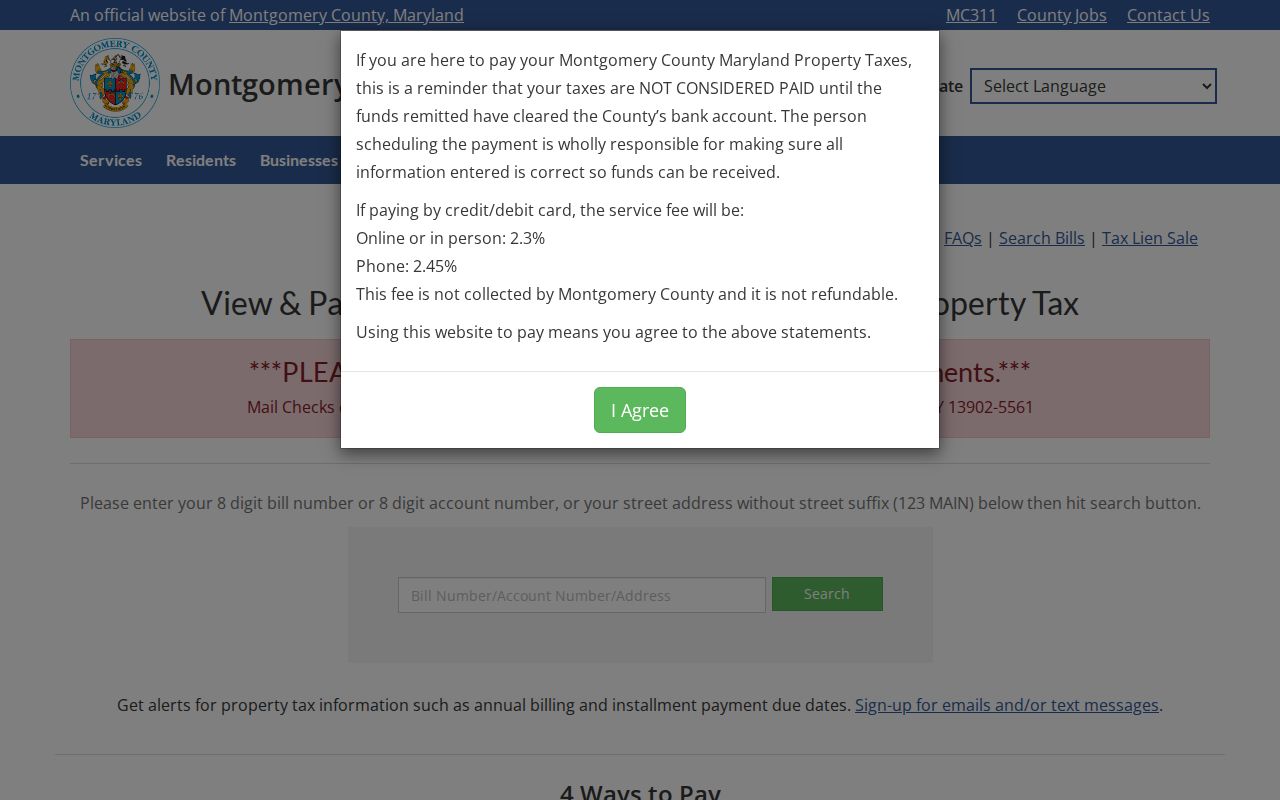
Bill and account searches sit apart from address search on the form. That separation helps you avoid mistaking a partial street match for the final parcel.
Inspect a Montgomery Tax Bill
Save any bill detail with its tax year and posting date. The official 2026 sample lays out the full field set: account, district, subdivision, tax class, lot, block, address, assessment, tax lines, occupancy, and plat text. Charges such as refuse or water-quality items can sit right beside the property-tax lines.
View the county's inspectable sample tax detail to see how the layout reads.
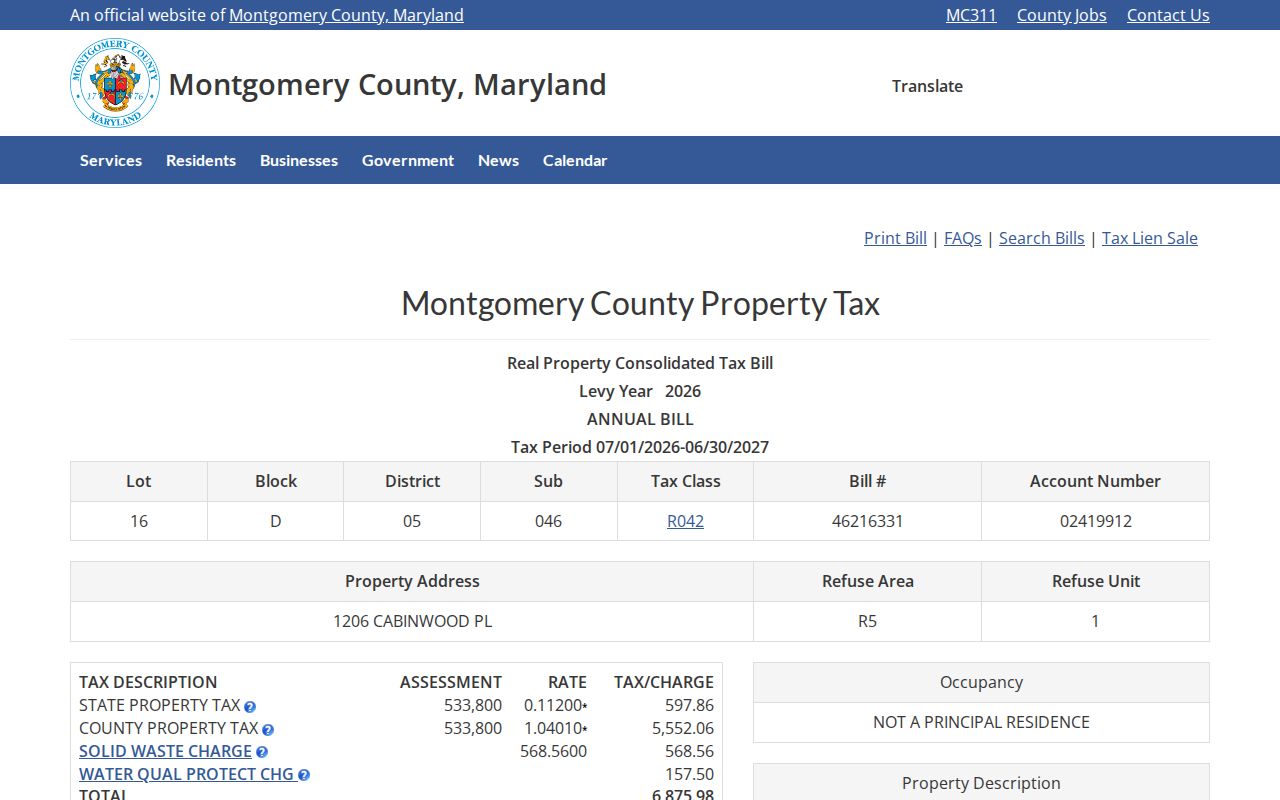
The sample makes one habit clear. Check the account number and plat description before tying any payment or status to a street name alone.
Separate Montgomery Assessment Values
Montgomery County reassesses every property on a three-year cycle. Any increase in full market value phases in equally across those three years. SDAT can display base, current, land, improvement, total, preferential, and phase-in values. Each label plays its own role. A credit or exempt amount lowers the tax without erasing the underlying full value.
- Current value
- SDAT's full cash value at the most recent assessment.
- Assessment
- The phased full cash or use value to which tax rates apply.
- Tax rate or levy
- The rate applied by the taxing government to the taxable base.
- Homestead-related relief
- Principal-residence rules or credits that may limit or reduce tax.
- Tax lien
- A statutory claim arising from unpaid tax, not a new deed owner.
For a closer look at these value labels, see the Montgomery County property value record.
Complete a Montgomery Tax Lookup
Start with the account number if you have it. That key is more exact than a street search. It also carries straight back to SDAT. Then read the bill year, taxable assessment, charges, credit lines, and payment posting. Take each one at a time. County Treasury notes that the site updates on weekdays. A payment can take up to 72 hours to appear.
- Search Treasury by the eight-digit bill or account number; use the address only when neither number is available.
- Confirm the district, subdivision, lot, block, and property description before reading the balance.
- Compare the taxable assessment and credit fields with the SDAT parcel card for the same year.
- Record the payment or delinquency status and the date checked. Use the annual tax-sale notice for any claimed sale status.
- Assessed value
- The value assigned by SDAT under Maryland assessment rules.
- Taxable assessment
- The value base used on the bill after applicable phase-in or relief.
- Payment posting
- The date a received payment becomes visible on the county site.
- Delinquency
- A bill not paid by its due date, which can accrue statutory charges.
Track Montgomery Tax Liens Carefully
Montgomery County sells tax liens at its annual sale, not houses. Annual and first semiannual payments are due September 30 and turn delinquent October 1. The second installment is due December 31 and becomes delinquent January 1. After credits, delinquent net tax accrues interest and penalty at 1 2/3 percent per month.
Each document marks a different stage. The stages include the annual notice, account page, sale result, certificate, redemption record, Circuit Court foreclosure, and collector's deed. A listed owner keeps possession and ownership rights throughout the redemption period. A final foreclosure of redemption changes that status. Never treat a sale-result entry as the current owner of record.
Review the current delinquent-property notice and bidding instructions for the stated sale year.
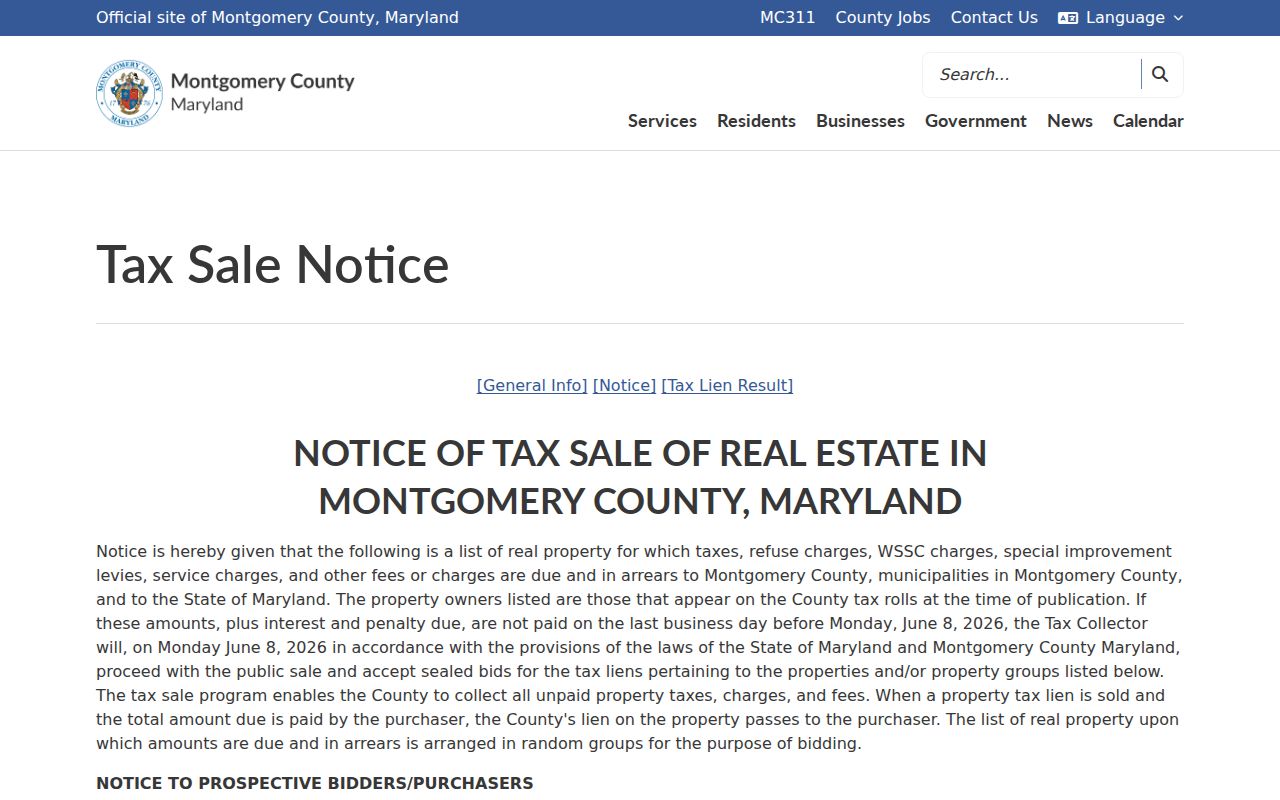
The notice is time-sensitive material. The results archive spans 2003 through 2025, while the current procedure page points to the next scheduled sale.
Appeal Montgomery County Assessments
A first reassessment appeal must be filed within 45 days of the Notice of Assessment. The online form asks for Montgomery County, the notice number, and the control number. Only the property owner may file, per the official process. A paper form can go to the local assessment office instead. SDAT supplies a free worksheet and an area sales listing for the informal supervisor hearing. That hearing typically runs about 15 minutes.
A Petition for Review is due in a non-reassessment year. The deadline is the first working day after January 1. A qualifying new owner who buys between January 1 and June 30 gets 60 days to appeal. The clock starts once the deed is recorded. A PTAAB appeal is due within 30 days of the supervisor's final notice. Maryland Tax Court review then follows within 30 days of the PTAAB order. The official summary lists no filing fee at these stages.
Open the SDAT assessment appeal form only after locating the notice and control numbers.
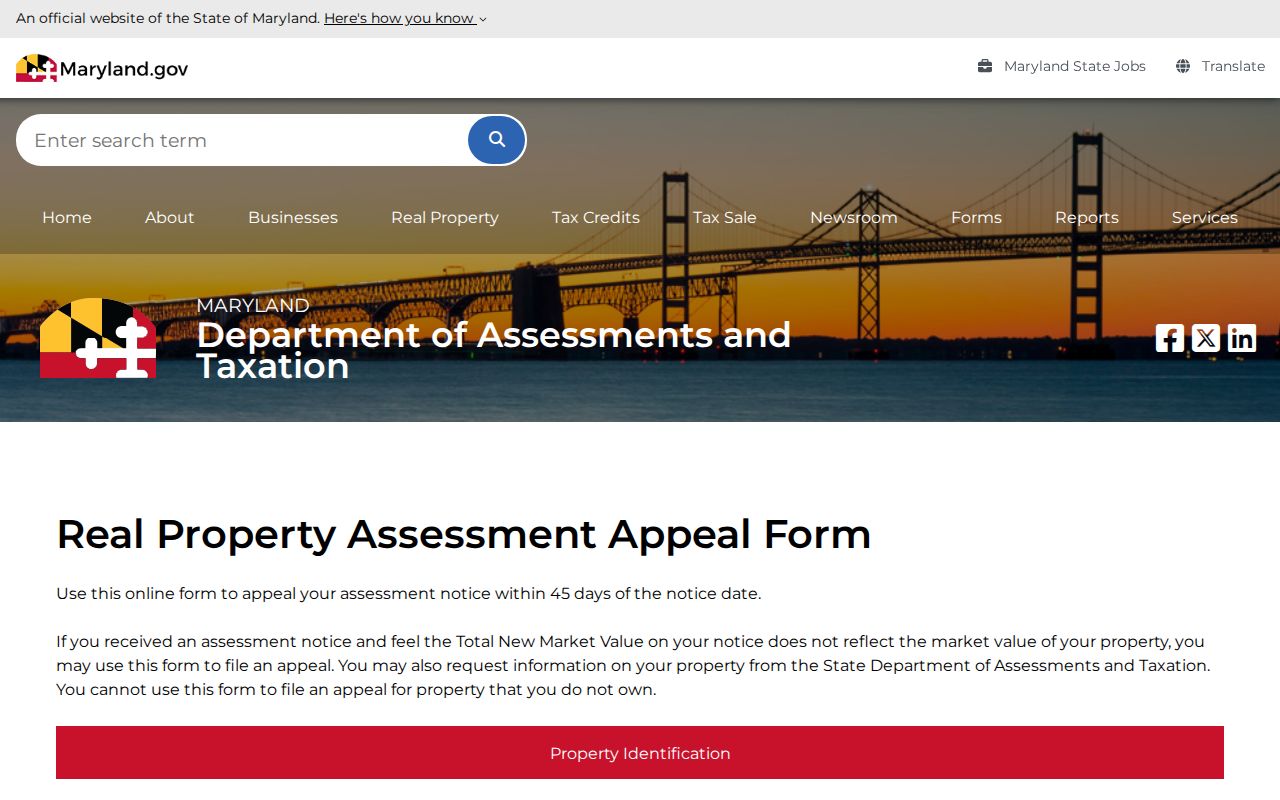
The screen shows that an address alone cannot start the online appeal.
Appeal window. File the first appeal within 45 days of the assessment notice. Later review stages each have separate 30-day limits.
Access Montgomery Tax Records Offline
A portal is not the only way in. The County Treasury handles questions about bills, payments, duplicate copies, delinquency, and tax sales. Want a hard-copy duplicate bill? The county charges $10, takes written requests, and quotes a two-to-three-week turnaround. Card processor fees run 2.3 percent online or in person and 2.45 percent by phone. Confirm current costs before paying, since vendors can change them.
Assessment records and appeal worksheets sit with the Montgomery SDAT assessment office, not Treasury. Is your request large or non-routine? Go to the proper custodian under the Maryland Public Information Act. Spell out the address, PAN, bill year, record type, and date range. Ask for electronic delivery and a fee estimate. The first two hours of search time are free under the Attorney General's summary. Reasonable search, review, and copy fees may follow.
Avoid sending a broad request to Land Records for a tax balance. Also skip Treasury for an assessment appeal file. The custody split explains a common puzzle. Two official Montgomery County property tax records can carry different dates. Both stay accurate for their own purpose.
Compare Montgomery Tax Record Dates
One parcel can carry several valid dates at once. SDAT shows an assessment year, a reassessment date, and phase-in dates. It also shows a transfer recordation date and sometimes a data date. Treasury works from a tax year, bill-posting date, installment due dates, and delinquency dates. It adds payment receipt and website posting. Tax-sale records add their own stages. Notice, publication, sale, redemption, court, and deed each carry a date.
Label every date to avoid false claims. A payment receipt can be newer than the website status during the stated posting delay. A new deed can appear before the next assessment roll update. A tax-sale result from an old year does not prove present delinquency. An assessment appeal can change value while leaving the deed owner untouched.
Credits demand a field-by-field check. The parcel card may list homestead application status, Homeowners' Tax Credit status, and partial exempt assessments. It may also list occupancy and special tax recapture. The bill shows what relief was actually used for that bill year. Never assume a principal-residence code guarantees every credit. A prior credit may not carry to the next bill.
For value evidence, SDAT offers a free worksheet and area sales listing during appeal. Screen comparable sales for date, location, property type, and whether the transfer was arm's-length. Recorded consideration helps. But exempt, family, estate, or otherwise unusual transfers may not reflect market value. Keep the evidence date aligned with the January 1 assessment basis.