
Compare Value Types on Montgomery County Records
A parcel card keeps these value ideas separate for good reason. Read the labeled field and its date first. Only then line the parcel up against a sale or another property.
| Value | What It Is | Where |
|---|---|---|
| Current or full value | SDAT's full-cash market-value estimate at the assessment date | SDAT parcel card |
| Phase-in assessment | The staged amount used as a rising assessment is phased over three years | SDAT and tax record |
| Last sale consideration | Amount reported for the recorded transfer, which may not reflect an open-market sale | Transfer Information and deed |
| Land and improvements | Separate components supporting the total assessment | SDAT value lines |
A sale consideration describes one transaction. A current value is an assessment estimate tied to a set date. The phase-in amount exists for tax timing. Because each measures something different, none can stand in for the others.
Read Montgomery County Land and Improvement Values
The SDAT parcel card reports base value and current value. Each one is split into land, improvements, and a combined total. It can also display phase-in values with their dates. Preferential land, partial exemptions, homestead status, and the assessment year appear there too. Structure facts like year built and living area are included as well.
This is why two totals on one card can both be official. One may be the full value. The other may be the taxable phase-in for a given year. Keep the label and date with every number you copy.
Place Montgomery County Values in the Three-Year Cycle
Maryland SDAT reassesses each property on a three-year cycle. Any increase in full market value phases in equally across those three years. That schedule explains the gap you can see on one record. A full current value and a phase-in assessment can differ for the very same property.
SDAT works from cost and sales-comparison analysis. Its Area Sales Analysis walks through comparable sales and assessed-value-to-sale-price ratios. A sound comparable needs the right property, a relevant date, and a matching transaction type. Resist stretching it into an invented appreciation rate.
Look Up a Montgomery County Assessed Value
Start with SDAT, since it is the state assessment authority. Match the parcel identifiers carefully. That step keeps the value attached to the correct lot or condominium unit.
- Select Montgomery County in the SDAT Real Property Data Search.
- Search by premises address, exact PAN, or map reference.
- Record assessment year, base and current land, improvements, total, and phase-in values.
- Read Transfer Information and open the deed reference when sale consideration matters.
- Compare only suitable sales with dates and arms-length status identified.
- Assessed value
- The official amount used within Maryland's assessment and tax system.
- Market value
- SDAT's full-cash estimate at the valuation date.
- Assessment ratio
- A relationship used when comparing assessment and sale evidence.
- Consideration
- The amount reported with a recorded transfer.
- Reassessment
- The periodic reset of the property's official value.
Compare Montgomery County Sale Consideration With Value
SDAT's Transfer Information can list the seller, recordation date, and consideration. It can also show the transaction type. Deed 1 or Deed 2 may appear there too. The recording date can lag the closing date. A family transfer, estate deed, or exempt transaction can make consideration a weak market benchmark. A partial interest can do the same.
For title context, pull the referenced instrument through MDLandRec. Treat a comparable sale as usable only after checking its date. Check its property characteristics as well. Confirm the arm's-length designation too.
See Why Montgomery County Value Labels Matter
An official 2026 hearing packet offers a dated SDAT example for a Silver Spring parcel. Land value is listed at $206,900. Improvement values shift from $282,000 to $355,700. Totals of $488,900 and $562,600 appear alongside a phase-in amount of $513,467. The same card notes a 1992 arm's-length sale at $208,000.
Do not mash those figures into a growth claim. They come from different dates and different fields. Those fields hold old consideration, newer full values, and a phased figure. The card's legal description, account, assessment year, deed reference, and transfer type supply the context. That context keeps each number honest.
Recognize Montgomery County Permit Signals in Valuation
SDAT's Pending Permit field signals valuation tracking, not proof that construction sits unfinished. The agency's glossary notes that qualifying additions can trigger an out-of-cycle assessment. County or city permit systems may clarify work that changed structure facts. A permit alone still does not set market value.
Line up the assessment date with permit issue and final dates. Rockville's permit history splits around October 25, 2021. One side of the split is MGO. The other side is the older Permit Plan system. One search may miss part of the improvement record.
Open Montgomery County's Value Search
The official SDAT interface asks for a county and a search method before returning the value-bearing parcel card.
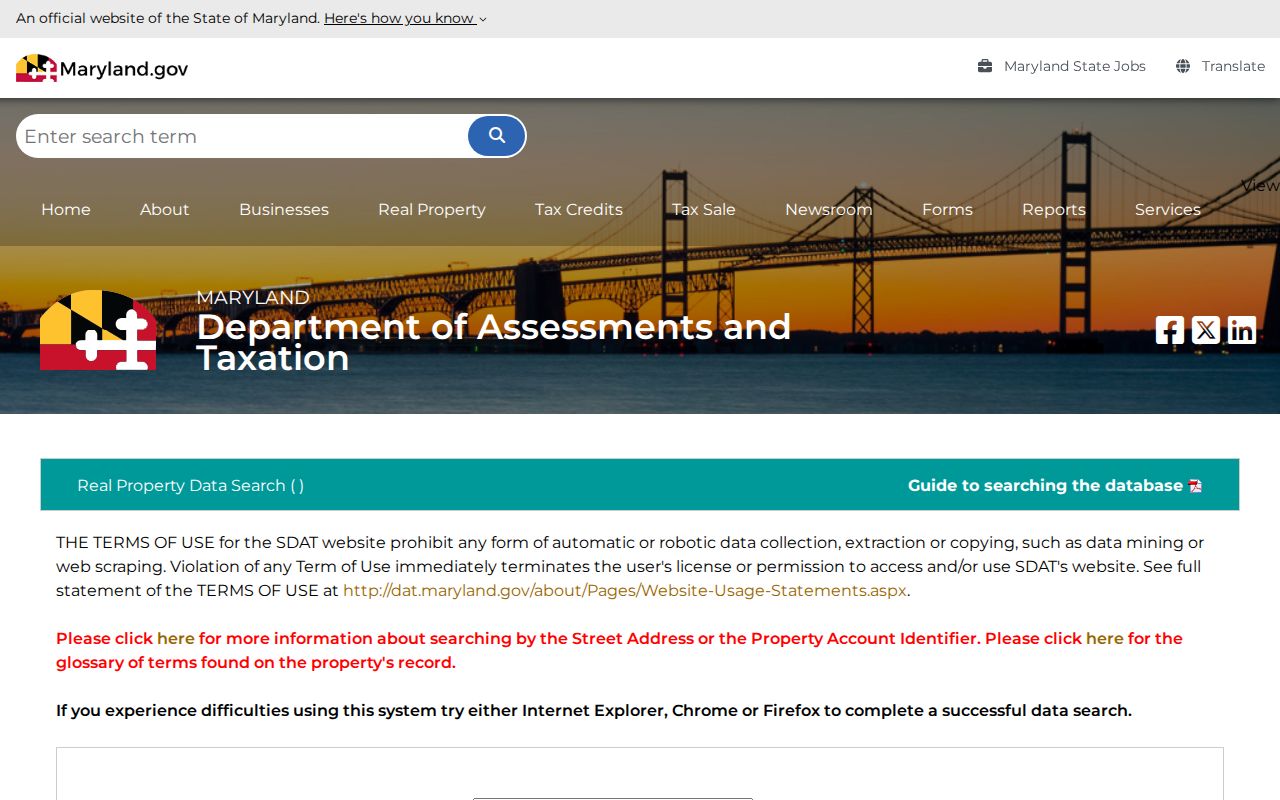
Address, account, and map routes all reach the same official value fields. An owner name or ZIP does not work as a direct search key.
Date Every Montgomery County Property Value
SDAT holds assessment, valuation, phase-in, and transfer dates. Treasury keeps tax, bill, payment, and posting dates. A deed and a GIS layer each carry their own.
Align those clocks before comparing values. A January assessment and a later sale describe different moments, so log the source, the field label, and the date you retrieved it.
Reach Montgomery County Value Records Beyond the Portal
SDAT handles assessment questions and gives worksheets to eligible owners or their representatives. Treasury maintains the bills. An online duplicate bill is free. A written copy costs $10 and can take two to three weeks.
For a nonroutine record, send a focused public-information request. Include the address, PAN, year, field, and date range. Request electronic copies and a fee estimate. That route can recover a historical value, but it is no substitute for an appraisal.
Understand What Montgomery County Property Value Cannot Tell You
An assessed value is not a promised sale price. It is not a listing appraisal. Nor is it a title opinion. It cannot settle condition issues, private contract terms, legal boundaries, or unrecorded rights. A licensed appraisal addresses a specific valuation purpose and date, while a survey settles boundaries.
Value is not price. Montgomery County's assessed value serves the public assessment system. It is not what a property is guaranteed to sell for and is not an independent appraisal.
Tax bills, credits, exemptions, payment status, and appeals raise separate questions. The Montgomery County property tax records guide covers them. This value page stops at where the figures live and what they mean.
Cross-Check Montgomery County Value Components
Values sit on top of facts, so check those facts first. SDAT lists year built, living area, stories, baths, garage, exterior wall, and quality grade. Those details sit alongside the land and improvement lines. It also reports land area, basement, and any improvement notices attached to the account. When a comparable looks off, one of these details usually explains the gap. A mismatch does not by itself prove the assessment is wrong. Match the identifiers too. Check the account, map, grid, parcel, subdivision, lot, block, plat, premises, and town code. For market evidence, stick to suitable arms-length improved sales with known dates and traits. An exempt transfer is not a clean price signal. The same goes for a family conveyance, estate deed, or partial-interest sale. Remember that the assessment is mass appraisal. A licensed appraiser values one property for a specific purpose and date.
Exemptions and occupancy can shift the taxable figure. The value estimate itself stays the same. A parcel card may show partial exempt assessments by state, county, or municipal class, plus special tax recapture, homestead application status, and Homeowners' Tax Credit application status. Those items explain why a tax calculation drifts from full current value. Credits, billing, and appeals belong to the property-tax record, not the value comparison. Permit timing matters as well. SDAT's Pending Permit label only means the agency is tracking permit information for valuation. It does not say work is unfinished. Some additions trigger an out-of-cycle assessment. Line up the permit application, issue, inspection, and final dates against the assessment date and the structure facts on the parcel card. City properties need the local permit system in addition to County DPS. Rockville, for instance, splits many applications around the October 25, 2021 transition from the older Permit Plan system to MGO. A missing result in one system does not prove no improvement occurred.