
Read Montgomery County Deed Records
A deed moves land from grantor to grante. It names both parties. Consideration appears where it applies, and the legal description fixes the parcel. Recording then adds a stamp and a liber-folio reference to the instrument. Montgomery County Land Records also indexes assignments, releases, and other papers. These burden, change, or release an interest. The label is only a start; the full text controls what the document does.
| Deed Type | What It Does | Common Use |
|---|---|---|
| Deed | Transfers the stated real-property interest | Sale, gift, or other conveyance |
| Corrective deed | Corrects wording or facts in an earlier instrument | Name or legal-description correction |
| Trustee or estate deed | Conveys under stated fiduciary authority | Estate or court-supervised transfer |
| Deed of trust | Records a secured interest rather than ownership transfer | Real-estate financing |
| Release or satisfaction | Records discharge of a prior lien or deed of trust | Completed payoff |
Deeds rarely sit alone in the deed records. Assignments, leases, liens, judgments, easements, plats, notices, powers of attorney, and recorded financing statements may sit beside them. A deed of trust is not an ownership deed. A release should connect to the interest it discharges. Keep every book-page number, and never assume that a shared party name means the same parcel.
Follow Montgomery's Grantor-Grantee Index
The Clerk indexes each instrument by party name and role. Montgomery County entries run through MDLandRec. Search individuals or corporations. Try grantors or grantees. Narrow by date ranges, document type, remarks, book and page, and the tax account. Entries are alphabetized and proofed. Yet initials, spelling variants, trusts, estates, and entity names still demand care from anyone tracing a parcel through the deed records.
- Find the latest deed from the SDAT Deed Reference or search the current owner as grantee.
- Read the grantor, prior-deed reference, legal description, tax account, and recording date.
- Search that grantor as an earlier grantee. Compare the legal description before accepting the link.
- Repeat the process, moving to historical indexes, volumes, or microfilm when the electronic series ends.
- Grantor
- The person or entity that transfers the stated interest.
- Grantee
- The person or entity that receives the stated interest.
- Chain of title
- The linked sequence of recorded instruments for the same land.
- Liber and folio
- The deed book and page reference used to retrieve a Montgomery instrument.
Search Montgomery MDLandRec Fields
The MDLandRec repository is free after email-account registration and works from any remote computer. Courthouse terminals offer it as well. Select Montgomery County first. Party search covers last, first, middle, suffix, legal capacity, ownership type, and grantor or grantee role. Document type and remarks accept text. Date controls handle all dates, a range, before, after, or one date. When names blur, a direct book-page jump bypasses the spelling problem.
Montgomery supports tax-ID search directly. That makes the assessor's tax account a strong bridge to the deed records. Results list party names, instrument type, recording date, and liber-folio, and opening the entry displays images where available. View the MDLandRec repository entrance before choosing Montgomery County.
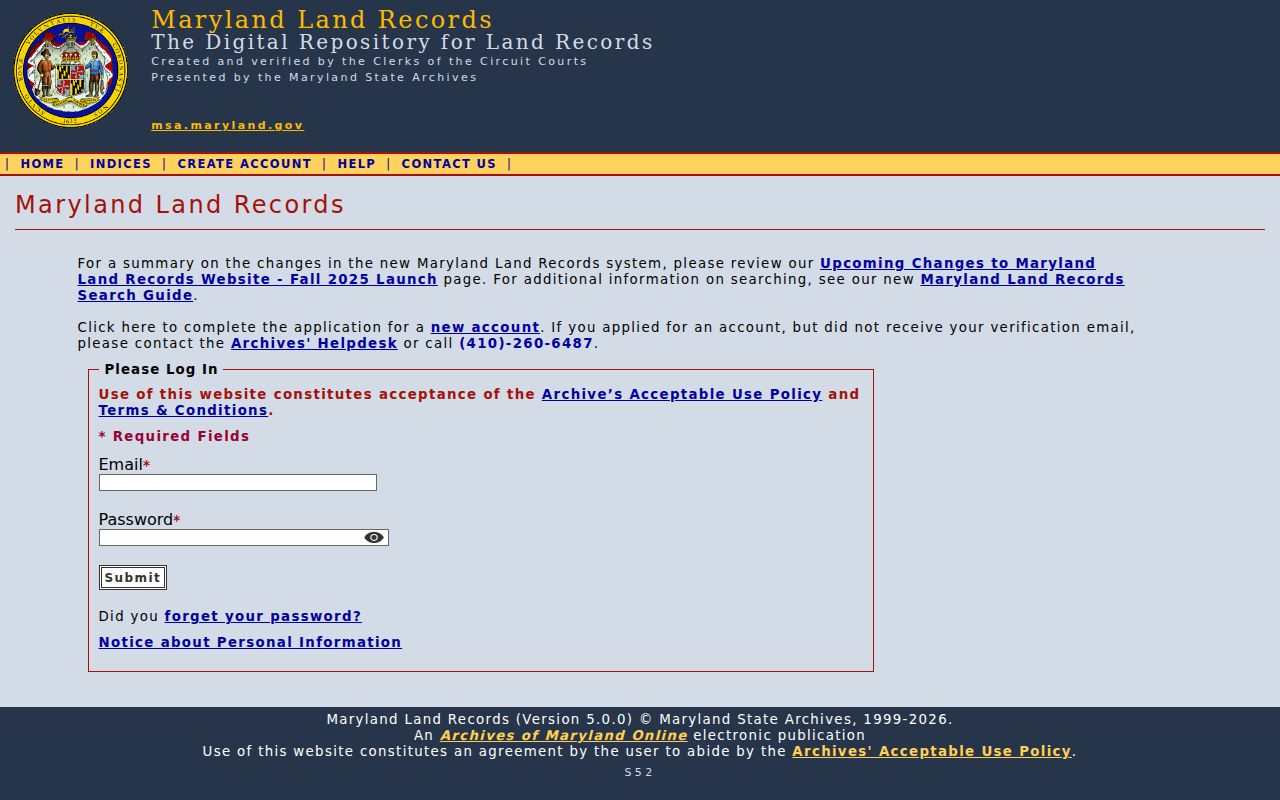
The repository is an instrument index and image system, not a modern street-address directory.
Reach Montgomery Deeds Beyond Indexes
Surviving Montgomery County land records reach back to July 1777. Digitized, indexed, and surviving are three different things. The historical equity index books span 1777 through 1981 at the Maryland State Archives. MDLandRec's Jump to New Volume tool reaches a pre-indexed record. The clerk initials, book, and page must be known. Microfilm duplicates from 1853 through 1993 sit in archive series T3411.
Older land rarely carries a modern address. Patents and tract names identify it instead, sometimes with acreage or metes and bounds. Montgomery History holds maps, atlases, property files, and directories. These can yield a prior owner or a book-page clue. Take that clue back to the official volume. Confirm the deed chain on the recorded image itself.
Note: Montgomery County has no known courthouse-fire loss of land records. A failed web search does not mean a deed is missing.
Match Montgomery Deeds to Plats
A deed's legal description may cite a subdivision, lot, block, parcel, easement, or recorded plat. Search Plats.net or Montgomery Planning's Record Plat Index for that reference. A subdivision plat shows property lines and easements. It does not show the house location, Planning cautions. The Land Records public room offers no individual house-location plats either.
Woodside shows why exact citations matter. An 1869 dedication sits at Liber EBP 6, Folio 213. A plat rests in Plat Book A. A later 1931 deed appears at Liber 528, Folio 114. The shared place name alone cannot prove all three concern the modern parcel being researched.
Verify Montgomery Deed Fraud Concerns
Test any suspicious mailing or title claim against the recorded instrument itself. Skip the commercial summary. Compare the grantor signature and acknowledgment, the grantee, the tax account, and the legal description. Check the execution and recording dates too. Look for any corrective or later deed, and when a lien is the concern, search releases, assignments, notices, and related court filings.
Montgomery County's official title-fraud guidance lists reporting routes. The county runs no separate property-fraud-alert signup. Assume none exists. For a live transaction or a disputed priority, consult a title professional or a Maryland attorney.
Order Montgomery County Deed Copies
Registered users view MDLandRec images online without a per-image charge. In person, use the Land Records Public Information Room in North Tower, Room 2120. Hours are weekdays, 8:30 a.m. to 4:30 p.m. Public computers there run MDLandRec. The county also describes mail inquiry and courthouse duplication routes for copies.
Plain and self-service copies cost 50 cents per page. Certification adds $5. A triple seal adds $10 plus the page charge. Pay by cash or check, not credit card. Self-service images use a Quick Key bought from Duplications in Room 2300. Call Public Information at 240-777-9477, Duplications at 240-777-9480, or Recording and Indexing at 240-777-9470 for the proper channel.
Review the official Montgomery Land Records room, hours, and fee instructions before visiting or sending a request.
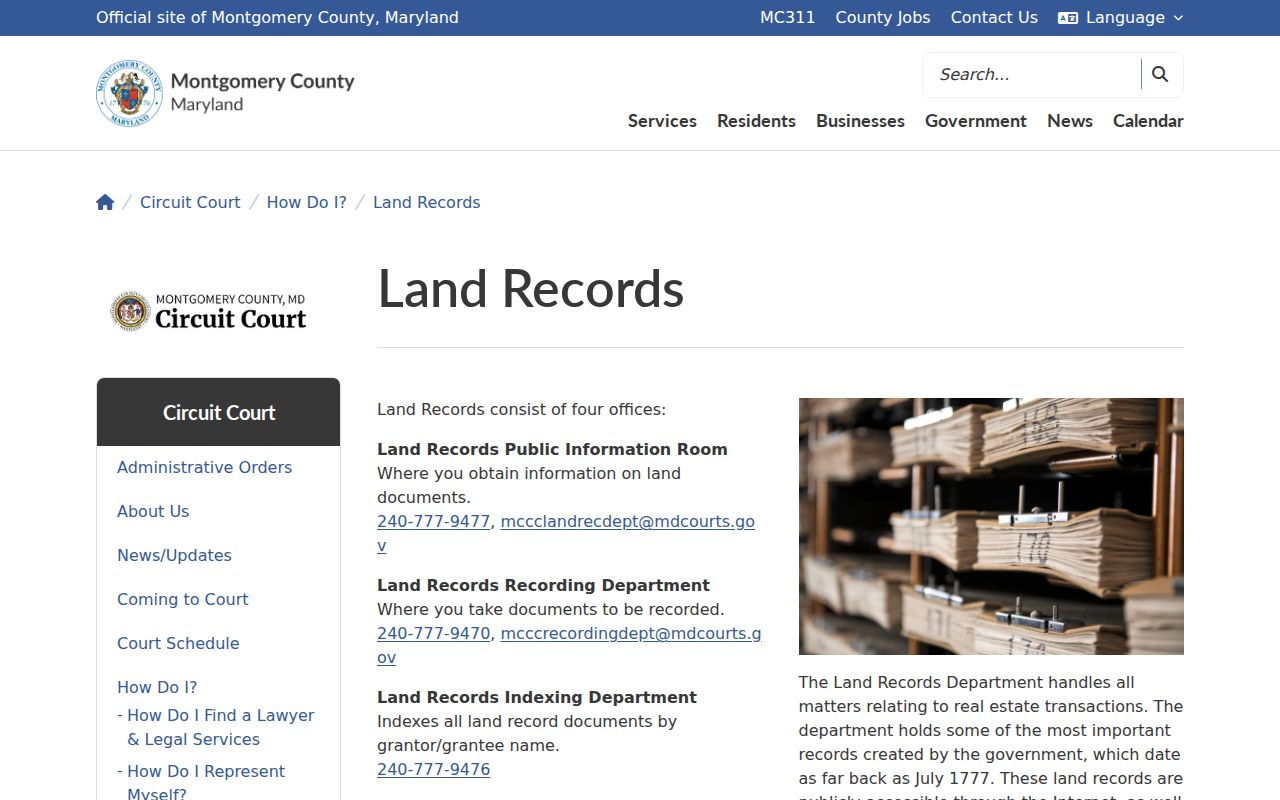
Montgomery County splits access into a free index and paid copies. Paper and certified copies cost money, so pick the format your task truly needs before ordering.
Recorded, not guaranteed. Montgomery County deed records show filed instruments. They do not reveal every unrecorded interest or supply a legal title opinion.
Record Montgomery County Deeds
Recording a deed is not the same as searching one. Montgomery County asks for an Intake Sheet, an SDAT copy, any required residency affidavit or Maryland Form MW 506 NRS, certification of preparation, and acknowledged grantor signatures, with the parcel ID or account printed on the deed itself. The Finance office transfers deeds at 27 Courthouse Square, Suite 221, Rockville. Electronic filing can reach Finance, yet the paper instrument still has to reach the Circuit Court. Fees follow the published schedule. A deed of nine pages or fewer that involves only a principal residence costs $20, while other deeds, or any deed of ten pages or more, cost $75. Most documents also carry a $40 surcharge. State transfer tax generally runs 0.5 percent of consideration, though a qualifying first-time Maryland homebuyer's principal-residence transfer can use the 0.25 percent rate when the legal conditions and sworn statement are satisfied. Those numbers will not predict your exact total. Length, transfer facts, taxes, exemptions, and instrument type all shape the bill. Call Finance at 240-777-8860 and Land Records indexing at 240-777-9470 before you present a document. A settlement professional can confirm the form is recordable.
Verify Each Montgomery Deed Link
Build a chain from identifiers, never from names alone. For every transfer, keep the execution date and recording date. Record the grantor, grantee, legal capacity, consideration, instrument type, liber-folio, tax account, legal description, and any prior-deed or plat reference. Then compare the next instrument's parcel identity. A surname or business name that recurs without matching land is not a chain link. Trusts, LLCs, estates, life tenants, spouses, and corrective deeds can fracture what looks like a simple sale sequence. Search each listed party and read the capacity beside every signature. A deed to two grantees may force both names into later searches. An estate deed deserves a check against the stated fiduciary authority. A life-estate deed can divide present and remainder interests. A short index line never explains those splits. Recorded burdens need their own chronology. A deed of trust lists a borrower, a trustee, and a lender. Later assignments may change the secured party. A release may be indexed under that party rather than the owner. Never assume a loan is open just because its original instrument shows up. Search releases, satisfactions, substitutions of trustee, assignments, and foreclosure filings tied to the same reference. Priority, payoff, an easement, or a pending transfer can be at stake. In those cases, stop at the evidence. Montgomery County deed records supply the filed instruments. An attorney or title professional determines their legal effect. That professional also checks for matters outside the visible index.